
Modern microelectronics manufacturing is placing increasingly stringent demands on surface tolerances. Operating at process nodes of single-digit nanometers, wafer flatness in semiconductor applications is fundamental to the sub-wavelength precision that lithography processes demand. Interferometry is the primary metrology technique for verifying those tolerances – and at this level of precision, measurement accuracy hinges entirely on the quality of the transmission sphere.
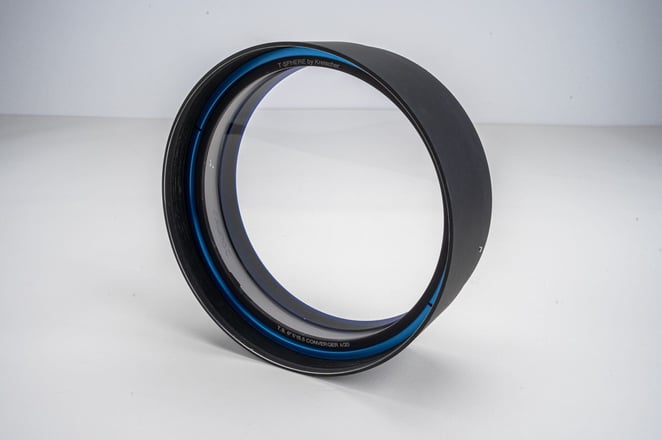
Lithographic systems have an extremely shallow depth of focus, and any variation in wafer surface height across a chip site pushes features out of that focus. Consequently, the surface flatness of silicon wafers must be held to sub-wavelength specifications. This also applies to the optical components inside the lithography equipment itself: microscope objectives, lenses, and mirrors all require equivalent characterization before use, and interferometry provides the non-contact, full-field measurement capability required to verify all three.
The Role of the Transmission Sphere
In Fizeau interferometry – the standard configuration for optical manufacturing and high-accuracy semiconductor surface metrology – the system outputs a collimated beam. A Fizeau transmission sphere converts this beam into a spherical wavefront that aligns with the curvature of the surface being tested. The final surface of the transmission sphere (the reference surface) then reflects approximately 4% of the light back as a reference beam, with the remainder converging to a focal point and diverging toward the test surface. The f/# specification of the transmission sphere governs the cone angle of that divergence, with complete surface coverage requiring this value to be equal to or faster than the R/# of the surface under test.
Any deviation detected by the interferometer is attributed entirely to the test surface, making reference surface quality critical. Pitch-polished reference surfaces produced to λ/20 and λ/40 surface accuracy ensure consistent surface figure and introduce no measurable error into the reference wavefront.
How Transmission Sphere Quality Determines Measurement Accuracy
Multiple aspects of transmission sphere fabrication directly affect measurement integrity. Non-uniform coatings degrade fringe contrast across the aperture of the reference surface, compromising surface quality and measurement reliability. Accordingly, low-scatter coatings need to be applied uniformly over the reference optic, and retrace error – introduced when light returning from an imperfect test surface deviates from its original path – must be minimized through optical design.
The Practical Challenges of Interferometric Testing
Interferometry is highly sensitive to vibration: anything that causes movement, such as mechanical and building-frequency disturbances, during the fraction-of-a-second acquisition, blurs interference patterns. For this reason, interferometers need to be mounted on a vibration-isolated optical table to capture reliable measurements.
Environmental conditions often present additional sources of metrological error. Air turbulence can cause light to bend, introducing noise into the system, and temperature drift can further degrade the signal as materials expand and contract along the optical path. The operating environment must, therefore, be air-controlled and thermally stable. While a poorly specified transmission sphere will exacerbate environmental and vibrational challenges, a precision-manufactured reference surface with tight surface figure reduces the burden on those controls.
Specifying for Sub-Wavelength Precision
In microelectronics, where metrology needs to resolve tolerances smaller than the wavelength of light itself, interferometry is indispensable. As one of the few techniques capable of operating at these sub-wavelength levels, such methods can only meet demanding specifications if every component in the optical chain is fabricated to equivalent precision.
At this scale, a transmission sphere becomes a precision instrument in its own right, with the measurement result no more accurate than the reference surface it depends on. At Torrent Photonics, we manufacture tranmission spheres in-house across 4” and 6” series, with proprietary Kreischer extended-range designs accommodating longer convex radii of curvature than comparable f/# transmission spheres. With more catalog-standard f/#s than found from other sources – filling the gaps in metrology coverage – and reference surfaces produced to λ/40 surface accuracy at 632.8nm, our transmissio -sphere line is engineered to meet the demands of high-precision interferometric measurement.
For guidance on specifying transmission spheres for high-precision interferometric measurement, contact our engineering team.