Defense and security Light Detection and Ranging (LiDAR) systems operate under the most rigorous conditions: low-observable targets must be acquired, operational cycles are continuous, and environments are unforgiving. In these sectors, airborne vibration, marine salt ingress, and armored vehicle thermal cycling are considerations commercial LiDAR specifications aren’t written for, and each defines a distinct optical engineering challenge.
Optical Challenges of Different LiDAR Systems
Across defense and security platforms, the optical demands of LiDAR systems are defined by the conditions in which they operate.
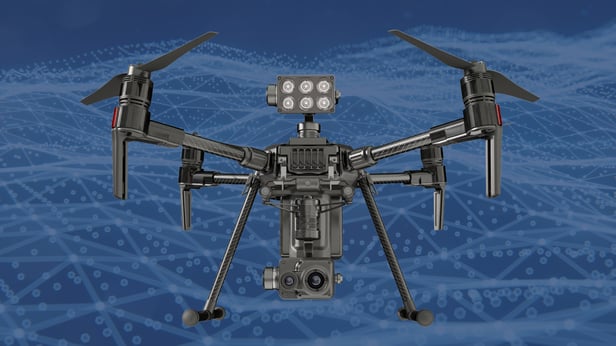
Rotary-wing unmanned autonomous vehicles (UAVs) present the sharpest tension, with their persistent rotor-induced vibration threatening beam alignment, yet stringent SWaP-C (size, weight, power, and cost) parameters limit the optical design solutions available to address it.
Fixed perimeter security installations run 24/7, resulting in sustained thermal stress on optics. This uninterrupted operation also means that spectral filtering must reject variations in solar irradiance and artificial lighting to ensure reliable detection.
Navy airborne LiDAR systems, such as airborne laser mine detection – commonly deployed from helicopter platforms over open sea – layer salt-fog, humidity, and solar glare off water surfaces onto the vibration and thermal demands of airborne missions.
On armored vehicles, LiDAR sensors support range finding and target tracking across broad thermal cycling, from sub-zero to elevated operating temperatures. This creates a coefficient of thermal expansion (CTE) mismatch between optical components and their mounts, introducing mechanical stress and positional deviation under temperature load.
Beam Steering & Optical Precision Systems
How a LiDAR system steers its beam and the optical integrity it maintains throughout that process governs whether it can perform reliably in any of these deployment conditions.
While mechanical beam steering – with its rotating mirrors and galvanometers – offers a wide field of view (FoV) and high resolution, it also introduces moving parts that are vulnerable to vibrational stress, shock loading, and frictional wear in defense LiDAR technology. Solid-state alternatives, including optical phased arrays and micro-electrical-mechanical system (commonly referred to as MEMS) mirror hybrids, eliminate the mechanical vulnerabilities associated with kinematic elements.
Whichever beam-steering configuration is selected, the laser optics within the LiDAR system’s transmission and detection channels must maintain beam quality and meet tight manufacturing tolerances. Scatter, wavefront error, and filter bleed-through don’t remain isolated optical problems; instead, they propagate into the point cloud as false detections. In defense applications – where real-time accuracy is non-negotiable – this directly degrades situational awareness.
For component specifications, covering beam shaping, bandpass spectral filtering, receiver optics, and coating requirements, read our Optical Fabrication for LiDAR article.
Sensor Fusion & Chip-Level Integration
In defense and security, LiDAR rarely operates as a standalone system. Rather, it feeds data into a multimodal fusion architecture alongside radar, electro-optical/infrared, and radiofrequency sensors. Here, upstream optical quality determines the integrity of the combined picture, and scatter and false detections entering the fusion stack can’t be rectified during processing.
Miniaturization trends pose another challenge. Smaller UAVs and autonomous vehicles are pushing LiDAR onto solid-state photonic integrated circuits built on silicon photonics substrates, making optical assemblies increasingly compact – and, as physical margins shrink, fabrication tolerances become more critical.
LiDAR Platform Constraints & Optical Specification
For OEMs, the optical demands across these platforms translate into a set of engineering decisions that must be defined before component selection begins. The first and most consequential is laser wavelength – commonly near-infrared light at 905nm or 1550nm for LiDAR systems. This drives every downstream specification, such as detector type, filter center wavelength, coating parameters, and permissible pulse energy.
The platform’s operating environment governs coating durability requirements, substrate selection, mounting tolerances, and the SWaP-C envelope. Specifying optics prior to defining these constraints risks incompatibilities that can’t be corrected at component level. By establishing wavelength and deployment environment at the outset, OEM designers and engineers can build an optical specification around a fixed framework.
To discuss optical fabrication for your LiDAR platform or request a custom coating quote, contact our engineering team today.