
Used across multiple medical specialties, optical coherence tomography (OCT) regularly interrogates turbid, light-scattering and -absorbing tissues. While a high-performing light source may achieve 5µm axial resolution, if the optical components lack spectral precision, system performance can degrade to 8µm, 10µm, or worse.

In spectral-domain OCT (SD-OCT) – the most widely adopted OCT modality in clinical settings – returning light is dispersed along a line detector, where each pixel captures a discrete wavelength-specific intensity value, building up the interference spectrum. The deeper the tissue, the higher the frequency of fringe patterns in the interference signal, and the finer the spectral resolution required to reconstruct depth accurately.
While the light source can set the performance ceiling, the optics dictate whether the system can reach it. Poor-quality spectral components cause roll-off, with resolution degrading progressively with imaging depth, and crosstalk between adjacent channels eroding fringe contrast and signal-to-noise ratio (SNR).
Transmissive Diffraction Gratings
Acting as the fundamental spectral separation in SD-OCT applications, transmissive diffraction gratings separate broadband returning light into constituent wavelengths along the line detector. Here, high diffraction efficiency maintains optical throughput, limiting insertion loss and sustaining SNR.
Grating line precision is equally critical. The accuracy of line spacing determines the consistency of wavelength mapping across the detector, and any imprecision introduces mapping errors that propagate into the depth reconstruction. These lines are patterned onto a substrate using a microlithographic process – the precision of which directly governs wavelength mapping consistency.
Precise grating geometry and low scatter are critical to maintaining clean channel separation, directly limiting crosstalk and fringe contrast degradation that compromise SNR at depth.
Precision Fabrication
Achieving optimal spectral performance relies on manufacturing accuracy at every stage. Discrete patterning on a single substrate accommodates reduced-footprint spectrometer designs and reduces assembly complexity, eliminating alignment error associated with stacking standalone filter components. In transmissive gratings, minimizing scatter and polarization-dependent loss (PDL) is critical to preserving throughput and SNR. Optical coating uniformity directly dictates channel accuracy, with any variation across a patterned substrate affecting diffraction efficiency and introducing intensity inconsistencies across the spectral range.
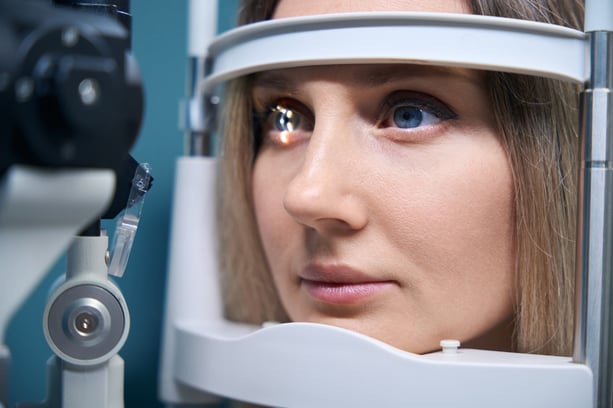
Spectral precision criteria vary significantly among clinical applications. Ophthalmology demands sub-10µm resolution for retinal layer discrimination, intravascular OCT implementations operate at 5-7µm resolution within compact catheter-integrated spectrometer designs, and dermatology enables non-invasive skin layer visualization at shorter tissue penetration depths.
These standards are most exacting in biomedical research settings, where dual-band configurations, polarization-sensitive imaging, and visible-light OCT (Vis-OCT) place demanding requirements on transmissive grating specifications.
Precision Optics for an Advancing Field
OCT’s inclusion as a named topic category at CLEO reflects the technology’s accelerating role in medical photonics and the appetite for ever-more-precise spectral components this advancement brings. At Torrent Photonics, we fabricate the high-precision transmissive gratings that enable OCT system integrators to realize the spectral performance these applications demand.
To discuss how Torrent's 20+ years of experience can help support your OCT work, simply reach out using our Contact page.