
Optical benefits and design trade-offs
Most imaging systems are built around commercially available CMOS or CCD image sensors. These devices offer a proven manufacturing foundation and are designed for reliable integration across a wide range of applications.
A key part of that sensor package is the protective cover glass. In many systems, the cover glass performs its intended function with little impact on performance. In others, it can influence optical design, spectral response, or integration requirements.
Addressing these limitations may require modification of the sensor package, including cover glass removal.
What the Cover Glass Does
The cover glass protects the sensor surface, microlens array, and bond wires during handling and operation while providing a durable outer surface.
Many sensors also incorporate optical coatings on the cover glass. For example, color imaging sensors commonly include IR-cut coatings, while some devices incorporate anti-reflection coatings to help reduce unwanted reflections.
From an optical perspective, however, the cover glass introduces additional interfaces into the optical path. While these effects are negligible in many applications, they can become significant in systems with demanding optical, spectral, or integration requirements.
When the Cover Glass Becomes a Limitation
Reflections and Imaging Artifacts
Reflections between the sensor surface and cover glass can create ghost images, veiling glare, and, in some illumination conditions, interference-related artifacts. Anti-reflection coatings can help reduce these effects, but may not eliminate them entirely, particularly in systems using narrowband illumination.
Optical Performance Considerations
A cover glass alters the optical path directly in front of the sensor. In high-performance imaging systems, particularly those using fast optics, this can influence focus and overall image quality.
Many commercial lenses are designed with the cover glass present in the optical path.
Removing it does not automatically improve performance. Depending on the system, optical adjustments, refocusing, or redesign may be required.
Spectral Response Limitations
Sensor cover glass materials and coatings can also influence spectral performance.
In some applications, the transmission characteristics of the cover glass may limit sensitivity at specific wavelengths. Likewise, coatings such as IR-cut filters may prevent access to spectral regions that are important for machine vision, sensing, spectroscopy, or scientific imaging systems.
For UV, NIR, and spectroscopy applications, the necessity of the cover glass and any associated coatings should be considered as part of the overall spectral design.
Integration Constraints
Physical separation between the sensor surface and external optical components is another common challenge.
Applications that use custom optical filters, patterned filter arrays, fiber optic components, or bonded optical assemblies often benefit from positioning those elements as close to the image plane as possible. The cover glass creates a fixed stand-off distance that can restrict those integration approaches.
In these situations, direct access to the sensor surface may be required.
When Cover Glass Removal Is Considered
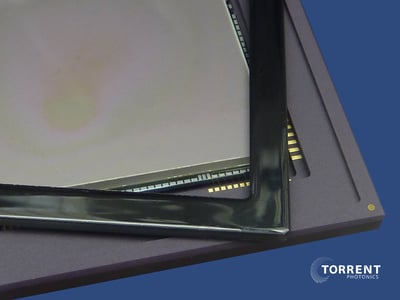
Cover glass removal is a specialist process requiring the expertise, equipment, and controlled manufacturing environment needed to work safely at the sensor level.
While relatively few organizations offer this capability in-house, Torrent Photonics provides both cover glass removal and subsequent image sensor modification services, allowing commercially available sensors to be adapted for specific optical and integration requirements. These modifications can include custom filter installation, fiber optic bonding, microlens removal, Bayer pattern filter removal and direct optical assembly integration.
Custom Filter Integration: Using in-house lithography and sensor modification capabilities, micropatterned optical filters can be installed and bonded directly onto the image plane. Positioning filter elements this close to the sensor can reduce stand-off distance and support custom spectral sensing configurations.
Fiber Optic Bonding: Cover glass removal is often a prerequisite for fiber optic bonding. Direct access to the sensor surface allows fiber optic faceplates, image conduits, scintillators, and related assemblies to be bonded directly to the detector. Direct bonding can improve coupling efficiency and simplify some imaging system designs.
Spectroscopy and Specialized Sensing: In spectroscopy and sensing applications, image sensor modifications are often driven by spectral requirements rather than imaging performance alone. Where cover glass materials or coatings limit access to required wavelength bands, alternative sensor configurations may be required.
Direct Optical Assembly Integration: Custom optics and optical assemblies can be bonded directly to the sensor after modification, reducing package size and simplifying higher level assembly.
Alternative Approaches After Cover Glass Removal
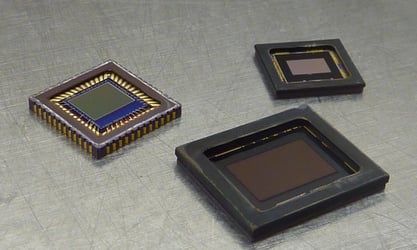
Removing a cover glass does not necessarily mean leaving the sensor exposed.
Depending on the application, the original glass may be replaced with an alternative window material, custom filter, or other optical element. Replacement cover glass options may also be available for certain applications.
Any exposed bond wires can also be protected using a conformal coating should it be necessary.
Understanding the Trade-Offs
Cover glass removal can provide significant integration benefits, but it also introduces challenges that must be considered during system design.
Contamination Risk: Once the cover glass is removed, the sensor surface becomes substantially more vulnerable to contamination. Particles that would be harmless on an external protective surface may directly affect imaging performance if they reach the sensor itself.
Environmental Protection: The original sensor package is designed to protect the sensor from moisture, particles, and mechanical damage. Modifying that package means environmental considerations, such as humidity, particulate contamination, and handling requirements, must be carefully evaluated.
Handling and Assembly: Removing the cover glass can expose delicate structures within the sensor package, including bond wires and other sensitive features. Sensor modification and subsequent integration require controlled handling and manufacturing processes.
Sensor Compatibility: Not all image sensors are equally suited to cover glass removal. Package construction, sensor architecture, manufacturing methods and camera configuration can all influence whether modification is practical. Sensor compatibility should therefore be evaluated early in the development process.
What Changes in Optical Design?
Cover glass removal changes the optical system immediately in front of the sensor.
In some cases, removing the cover glass changes the optical path and enables sensor-level modifications that would otherwise be difficult to implement. In others, optical adjustments may be required because the original design assumed the presence of the cover glass.
For this reason, cover glass removal is generally best evaluated as part of the overall optical system rather than as an isolated sensor modification.
Conclusion
Cover glass removal is not inherently better than a standard sensor configuration. The decision depends on the optical, spectral, and integration requirements of the application.
For systems requiring direct filter integration, fiber optic bonding, or bonded optical assemblies, sensor modification can enable configurations that are not possible with a standard packaged device.
We provide image sensor modification services including cover glass removal, microlens removal, custom filter installation, fiber optic bonding, and direct optical assembly integration for advanced imaging, spectroscopy, sensing, and machine vision applications.
Contact our technical sales team to discuss your requirements: sales@torrentphotonics.com