
Metrology is, at its essence, is the science of measuring.
For advanced photonics systems, metrology determines whether a design’s performance can be realized in practice. Even when every optic meets its criterion on paper, overall output is constrained by the integrity of the measurement chain behind those specifications. This means that the surface, wavefront, transmission, and alignment data must all be rigorously verified to ensure components deliver as intended. As the foundation of design validation and quality assurance, optical metrology provides quantitative evidence of how a system will perform.

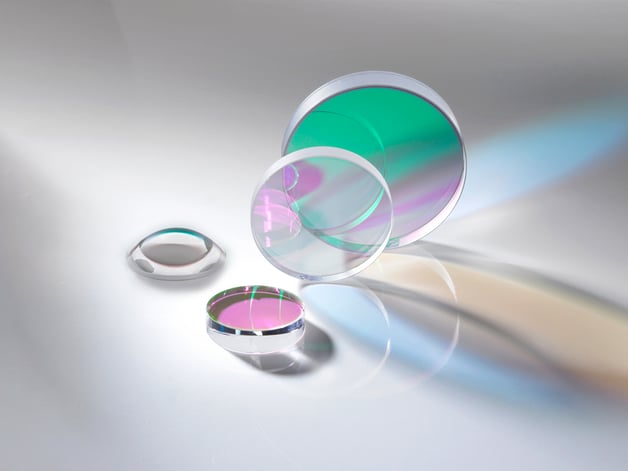
Without optical metrology, photonics is a series of assumptions waiting to fail upon deployment. A fixed set of parameters dictates whether an optic performs to as-designed standards: surface form, wavefront quality, roughness, cosmetic defect grade, and coating spectral response. Surface form errors directly produce wavefront errors, leading to reduced resolution in imaging systems and degraded beam quality in laser applications. Transmitted and reflected wavefront measurements confirm whether the design’s diffraction-limited performance can be achieved in operational conditions.
Surface topography, measured at nanometer scale, quantifies roughness, which drives scatter, stray light, and degradation of the signal-to-noise ratio (SNR). This effect intensifies at shorter wavelengths, with ultraviolet (UV) applications more sensitive than infrared (IR) ones. Visible defects, such as scratches and pits that can cause scattering and lower the laser-induced damage threshold (LIDT) of coated optics, are then graded according to scratch-dig specifications.
Coatings specified for wavelength-selective functions, for example, passing or blocking defined spectral bands, can deviate from their designated spectral profile due to deposition variations across the substrate. This causes in-band signal loss and out-of-band noise leakage, resulting in a system that falls out of specification.
Metrology Instruments & Methods
Each of these parameters corresponds to a particular measurement technique, and complete verification of an optic requires a full metrology suite spanning surface form, roughness, wavefront, and coating spectral response. Catching these deviations at a component level reduces downstream engineering risks during system integration and field operation.
Interferometry
Fizeau interferometry (such as our three Zygo systems and Apre interferometer) measures transmitted wavefront and surface form by analyzing the interference pattern generated against a calibrated reference wavefront, with transmission spheres providing the standard for curved optics. A white-light interferometer (like our NexView) delivers non-contact measurements of surface roughness and topography with sub-nanometer vertical resolution. For large-scale optics, stitching interferometry on platforms like our Zygo VFA can support components up to 22 inches in diameter.
Profilometry
For optics where surface contact must be avoided, including soft substrates and coated components, non-contact profilometers like our Luphoscan can measure freeforms and aspheres without the risk of damage or contamination.
Spectrophotometry
To establish a coating’s wavelength response across an operating band, spectrophotometers quantify in-band transmission and out-of-band rejection. This helps to verify whether a coated optic matches its intended spectral profile before integration into the final assembly.
Application-Specific Considerations
Depending on the end use, these parameters and the optical measurements that verify them translate into different priorities. For instance, applications like UV-VIS-SWIR multispectral and hyperspectral imaging depend on tight wavefront control and coating uniformity to deliver image quality. Spectrometers and Raman instruments require accurate coating spectral response and precise diffraction grating line spacing to maintain wavelength accuracy and SNR.
Meanwhile, industrial inspection optics must retain their form under continuous thermal cycling and vibration, with long-term stability as the critical metric. Components for laser-based systems combine all the above, with surface roughness, coating uniformity, and wavefront accuracy governing LIDT and beam quality at high fluence.
Precision Metrology for High-Performance Photonics
Advanced photonics is bounded by the precision of its components, and that can only be confirmed through optical measurements. Without them, performance simply becomes a matter of assumption rather than verification.
At Torrent Photonics, our optical component fabrication and R&D processes are built on metrology-driven design validation, supported by our ISO 9001:2015, AS9100D, and ITAR-registered quality procedures.
To discuss a project or optic with a member of our expert team, get in contact with us today.