
As an optics-based form of polymerase chain reaction (PCR), quantitative PCR (qPCR) relies on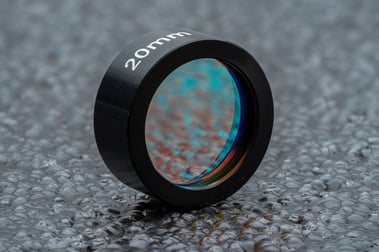 optical components to determine how faint a fluorescence signal a system can detect. Weak or poor-quality optics can result in missed signals, inaccurate quantification of the DNA present, and one dye’s signal bleeding into another. Many qPCR systems resolve up to six channels spanning the 450-720nm window, so these issues become critical to an instrument’s optical engineering.
qPCR instruments track a rising fluorescence signal from each well across successive cycles, with intensity measured either plate-wide or per-well. Because fluorescent dyes emit at a longer wavelength than the light used to excite them (the Stokes shift), excitation and emission occupy different parts of the spectrum. That separation lets filters isolate the weak emission signals from the much stronger excitation light.

The qPCR Optical Detection Pathway
The optical chain within these instruments typically follows a set sequence: light source, excitation filter, dichroic mirror, focusing optics, emission filter and detector.
- Light source: an LED, tungsten-halogen lamp, or laser determines which excitation bands are available and the stability of output
- Excitation filter: a narrow bandpass filter isolates the dye’s excitation band and keeps stray wavelengths off the sample
- Dichroic mirror: in epifluorescence designs, excitation is split from emission by wavelength, although some multi-channel instruments omit it
- Focusing optics: aspheric lenses or condensers capture LED divergence, while a Fresnel lens directs the beam into each well, maximizing light on the sample
- Emission filter: a bandpass filter passes the Stokes-shifted signal and blocks scattered excitation light
- Detector: a charge-coupled device (CCD), complementary metal-oxide-semiconductor (CMOS), or per-well photodiode converts the collected emission into a measured signal.
Accuracy, Dynamic Range & Limit of Detection (LoD)
Optical filters and coatings directly set the quantification accuracy, dynamic range, and limit of detection (LoD) of a qPCR instrument. In higher-end systems, excitation and emission filters can be decoupled. With around six of each (excitation: ~450-670nm, emission: ~500-720nm) combined freely, several dye channels can be read in a single run for multiplexing.
As those channels lie close together in wavelength, emission filters must cleanly separate them. FAM, HEX, ROX – three common qPCR dyes – emit at ~520, 559 and 602nm, each only ~40nm from the next. At such tight spacing, the filter has to selectively pass one dye’s signal while rejecting its neighbor’s. Any spectral leakage at this stage shows up as crosstalk between channels.
Steep filter edges and strong out-of-band rejection raise the signal-to-noise ratio (SNR) and reduce the LoD, while a uniform optical response over qPCR wells keeps readings consistent from low to high DNA concentrations.
Thermal Drift, Stray Light & Spectral Purity
Bandpass filters shift their center wavelength (CWL) as temperature rises. Because the reaction block can cycle up to ~95°C, the optical path must be thermally isolated from the heat source to keep filters within their operating limits and CWL steady. Scattered excitation light reaching the detector further complicates the design, raising the noise floor, so strong out-of-band blocking and shielding are required to keep it off the signal.
Prolonged or intense excitation degrades the dye during a run, so high-transmission optics that capture more of the emitted signal allow designers to use lower intensity, reducing bleaching. Spectral purity can be compromised by coating variation, which shifts the passband and weakens blocking, ultimately pushing a system out of spec.
At Torrent Photonics, we supply the filters, dichroic mirrors, and custom coatings that integrators design into qPCR systems – held to tight spectral tolerances, with wavelength‑specific filter sets and high‑uniformity optics for compact modules.
To discuss how we can support your qPCR work, contact our team today.