
Design with aspherics from the start
Many optical designers still assume aspheres are too expensive or difficult to manufacture. Advances in fabrication and metrology over the past 25 years have significantly changed that perception.
A single aspheric surface can often replace two to five spherical elements, reducing system size, weight, and assembly complexity while improving optical performance.
Spherical optics have limitations
A spherical lens cannot focus all incoming light to a single focal point. Light passing through the edge of the lens refracts differently from light passing through the center, creating an optical defect known as spherical aberration.
Reducing spherical aberration typically requires additional lens elements, increasing system complexity, size, and cost.
Aspheric surfaces provide an effective alternative. By precisely controlling the lens profile, we can reduce or eliminate spherical aberration with a single element, often replacing multiple spherical lenses while delivering superior optical performance.
The math has changed
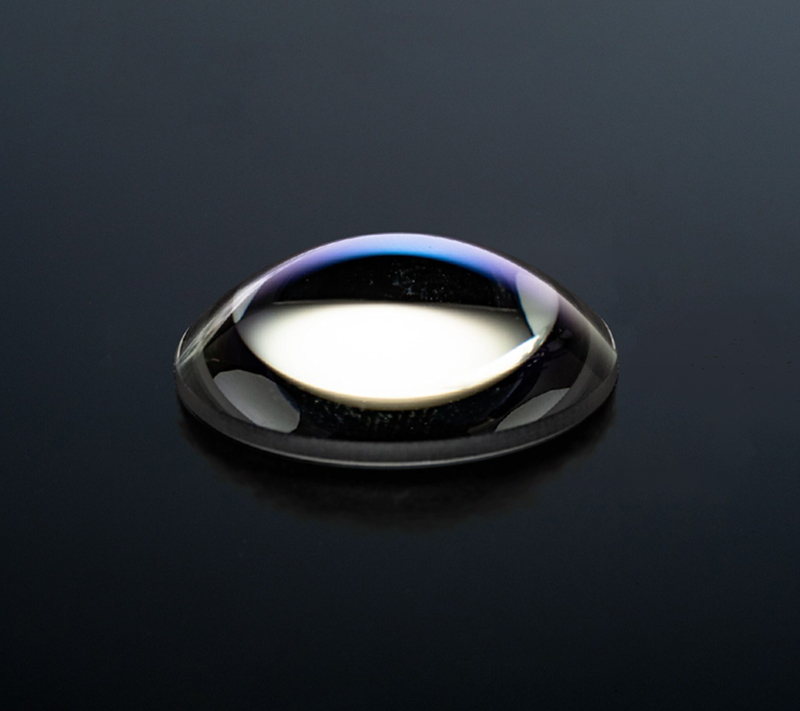
Historically, aspheric optics were 10 to 100 times more expensive than spherical optics and significantly more challenging to manufacture and test. Advances in fabrication and metrology over the past 25 years have reduced that cost premium to roughly 2 to 5 times, depending on the complexity of the optic.
For many optical systems, a single asphere can replace two to five or more spherical elements. When reductions in component count, assembly complexity, and system size are taken into account, the total system cost is often comparable to, or even lower than, that of an equivalent spherical design.
Cost: Aspheric optics are no longer the specialist solution many designers assume. In many applications, the performance gains justify the modest cost premium.
Lead Time: In prototype and low-to-mid-volume production, lead times are often comparable to those of spherical optics because the same fabrication infrastructure can support a wide range of aspheric geometries. Spherical optics retain an advantage at very high production volumes, but most custom optical programs do not operate at those scales.
Design Flexibility: We work with customers to evaluate where aspheres can simplify an optical design, reduce component count, and improve system performance while maintaining a practical manufacturing approach.
Myth: "Aspheres are too expensive for my application."
Today, advances in fabrication and metrology mean many aspheric designs can be produced at commercially viable costs. When a single asphere replaces multiple spherical elements, overall system cost, weight and assembly complexity can be reduced at the same time.
Precision that diamond turning and molding can't match
We specialize in conventional grind-and-polish asphere manufacturing. Using advanced fabrication, polishing, and metrology equipment, we achieve surface irregularities below 0.03 µm PV and surface roughness below 0.3 nm RMS, with aspheric surfaces certified to better than λ/20, depending on geometry.
Compared with diamond-turned or molded optics, conventional grind-and-polish techniques provide superior control of mid-spatial frequency errors. Larger-area polishing processes naturally produce smoother surfaces with fewer artifacts and lower ripple.
For laser, imaging, and metrology applications, surface quality can be just as important as overall figure accuracy. By minimizing scatter and controlling surface artifacts, we deliver optics with higher surface quality, lower scatter, and improved optical performance.
All under one roof, zero subcontracting risk
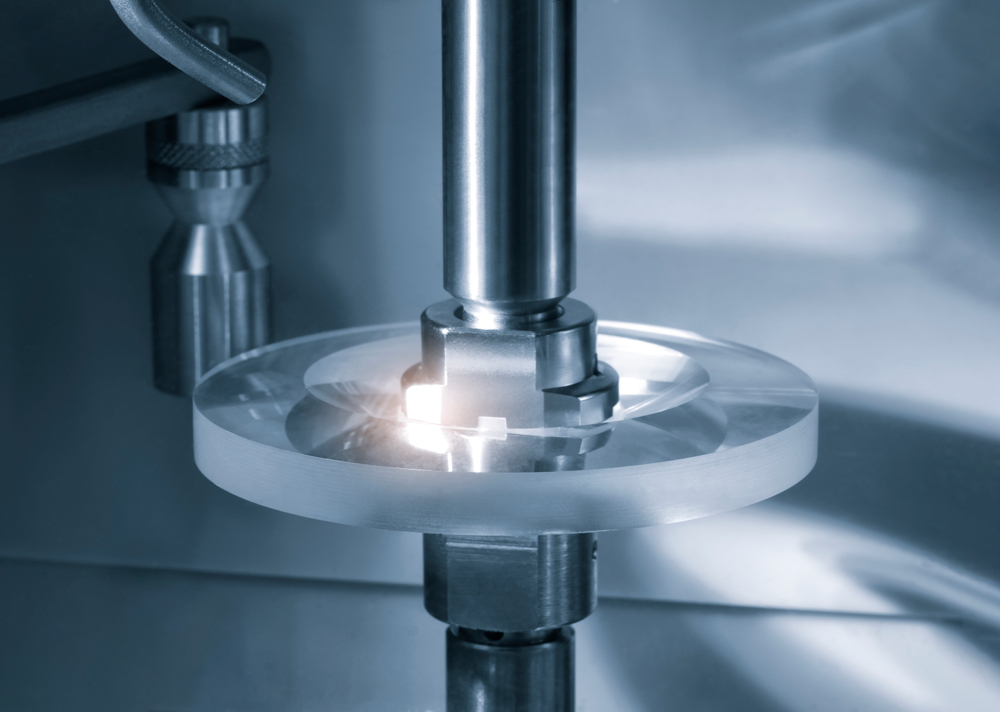
Fabrication, sub-aperture polishing, MRF finishing, metrology, coating, bonding, and assembly all take place in-house.
By keeping these capabilities under one roof, we reduce supply chain complexity, improve process control, and shorten turnaround times. This allows us to support high-specification projects that many suppliers decline because of technical risk, complexity, or subcontracting requirements.
Our advanced metrology systems certify parts to better than λ/20 PV, depending on size and geometry. Rather than relying on manufacturing claims, our customers receive measured, traceable data that verifies performance.
Decades of expertise, backed by scale
Kreischer Optics was an early pioneer in aspheric lens design and fabrication. Today, we build on that expertise as part of Torrent's broader manufacturing platform, supported by continued investment in CNC fabrication, metrology, coating, bonding, and assembly technologies.
Many optical designers are experts in system performance but may not always know which features are straightforward to manufacture and which introduce unnecessary cost, complexity, or lead time risk. We work with customers early in the development process to identify opportunities for practical optimization before designs are released to production.
This design-for-manufacturability approach is one of our key strengths. Small specification changes can often make an optic significantly easier to produce without compromising performance, reducing cost, shortening lead times, and improving overall project success.

"Most of the systems we see could become lighter, smaller and simpler by moving to a single aspheric surface. The challenge isn't usually physics. It's that many designers are working from assumptions about asphere cost and manufacturability that no longer reflect modern capabilities."
Tristan Kreischer
Senior Optical Engineer, Torrent Photonics
A customer approached Torrent with a custom aspheric design that could not be manufactured as specified. The aspheric equation quickly deviated out of manufacturable limits at the edge of the clear aperture, with the result that the customer’s design could not be reliably programmed into the manufacturing process.
Working directly with the customer's engineering team, Torrent redefined the surface equation into a form that could be clearly documented on the drawing and imported directly into the CNC workflow.
The revised design entered production and has remained in use for years, transforming what was initially close to a no-bid opportunity into a successful long-term program.
Capabilities
.png "Torrent Aspheric Capabilities Graphic (1)")
Where aspheres make the difference
Whether the goal is better imaging performance, more compact packaging, reduced weight, or improved beam control, aspheric optics are often the enabling technology behind modern optical systems.
High-performance, lightweight night vision and wearable optics; wider field of view; low surface roughness for laser and beam-shaping systems.
Precision UV/IR focusing optics for lithography, imaging and alignment, where surface quality and tolerance are non-negotiable.
Ultra-precision optics for satellites and imaging systems operating under extreme environmental conditions.
High-volume, high-precision optics for endoscopes and medical laser systems.
Ultra-precision telescope mirrors and custom microscope objectives for new, ground-up development projects.
Compact, high-performance spectrometers, sensing devices and machine vision systems.
Design with aspherics from the start
The earlier we are involved, the more opportunities there are to improve manufacturability, reduce cost and avoid development risk.
Whether you're evaluating an aspheric design, comparing spherical and aspheric solutions, or finalising specifications for production, our engineers can work with you to make the right decision.