
VIS spectroscopy is commonly used for color measurement, material identification and quality control. In manufacturing, a spectrometer can be integrated into an inspection system to provide objective spectral measurements for applications such as print assessment, product color verification and process monitoring.
Torrent's Renegade VIS spectrometer covers wavelengths from 350 to 790 nm and can be integrated into OEM analytical and measurement systems. Where an application also requires UV, NIR or spatial information, Torrent can help determine whether a different spectrometer or spectral imaging solution would be more suitable.
A spectrometer is generally suited to applications that require spectral measurements from a defined point, sample or optical input. The required wavelength range, resolution, sensitivity, integration time and available light all influence the choice of spectrometer.
If the application needs spectral information across an image or larger area, a multispectral or hyperspectral imaging system may be more suitable. These systems combine spectral and spatial information, allowing differences to be measured across a scene or sample.
Torrent can review the measurement requirements and help determine whether a spectrometer, multispectral camera, hyperspectral camera or customized spectral device is the most appropriate option. Torrent currently offers spectrometers alongside multispectral and hyperspectral imaging technologies.
Torrent develops OEM spectroscopy solutions for applications including medical and biochemical analysis, analytical instrumentation, environmental monitoring, industrial measurement, food and beverage analysis, and visible color measurement. The final design is developed around the requirements of the application.
The standard Renegade UV-VIS platform covers wavelengths from 190 to 850 nm, while the standard Renegade VIS platform covers wavelengths from 350 to 790 nm.
For OEM applications, Torrent can develop custom spectrometer solutions with wavelength ranges outside these standard configurations, including extensions into the near-infrared (NIR), depending on the application requirements.
The standard Renegade UV-VIS spectrometer covers wavelengths from 190 to 850 nm, with 1.25 nm FWHM optical resolution. Other ranges are possible.
Yes. Demonstration units of the Renegade UV-VIS and Renegade VIS spectrometers are available, allowing engineers to evaluate performance before progressing to a customized OEM design.
Yes. Torrent develops OEM spectrometers around application-specific requirements, including wavelength range, optical resolution, throughput, slit configuration, detector selection, communications interfaces, firmware, software and mechanical integration.
The Renegade UV-VIS and Renegade VIS platforms can also provide a starting point for OEM development. Depending on the application, Torrent can adapt optical, electronic, mechanical and software elements to meet specific performance and integration requirements.
When developing a custom spectrometer, wavelength range, optical resolution and throughput are reviewed together because changes to one parameter can affect the others.
To begin the discussion, it is helpful to provide the required wavelength range, optical resolution, throughput, integration requirements, expected production quantities, and any size, interface or environmental constraints.
If every specification has not yet been defined, Torrent's engineering team can help identify the requirements most relevant to the application.
Ideally, Torrent should be involved during the early stages of system development, allowing optical, electronic, mechanical and software requirements to be considered together and helping to reduce redesign later in the project.
Torrent's Renegade spectrometers are designed for integration into OEM analytical and measurement systems. Their compact, fiber-coupled design allows them to be incorporated into handheld, benchtop and embedded instruments. Renegade spectrometers have also been integrated into commercial chemical analysis platforms.
Integration requirements may include wavelength range, optical resolution, input fiber, triggering, communications interfaces, firmware and mechanical packaging. Depending on the platform, available interfaces include SPI and USB, with custom options available for OEM programs.
The Renegade platforms support internal and external trigger sources, while Torrent can also provide firmware, API development and communications support to help the spectrometer communicate with the wider instrument or control system.
Yes. Support can extend beyond the spectrometer itself to include electronics, firmware, API development, communications interfaces, light-source control, additional sensors, mechanical integration and complete box-build solutions.
Environmental and operating requirements, such as temperature, humidity, vibration and packaging constraints, can also be considered as part of the system design.
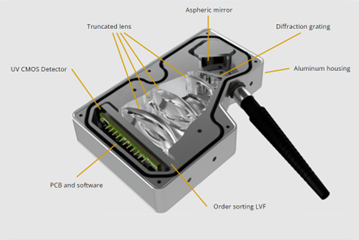
The diffraction grating separates incoming light into its component wavelengths and is therefore a critical part of the spectrometer's optical design. Its efficiency, groove density and material affect wavelength coverage, optical throughput and resolution.
The Renegade platforms use Torrent's fused silica transmission gratings. The gratings are designed and manufactured in-house, allowing their performance to be considered as part of the complete spectrometer design.
For custom OEM programs, the grating can be developed alongside the optics, detector, electronics and firmware to support the required wavelength range, resolution and throughput.
Yes. Torrent designs and manufactures transmission diffraction gratings in-house. This allows the grating to be developed as part of the complete spectrometer design rather than sourced as a separate standard component.
Detector selection depends on the wavelength range, sensitivity, integration time and other performance requirements of the application. Torrent can review detector requirements as part of the overall spectrometer design.
Yes. Torrent supports OEM customers moving from product development into commercial volume production. Its spectrometer programs are intended for products requiring ongoing manufacture rather than individual, one-off instruments.
Not necessarily. Torrent manufactures key optical components in-house, reducing reliance on separate third-party suppliers and associated markups. This can make a customized solution more cost-effective than customers initially expect.