
Prisms are used throughout optical systems to deviate beams, erect images, split light paths and return beams to their source. In many applications, the choice of prism affects not only optical performance but also the size, packaging and alignment of the overall system.
Rangefinders, night vision devices, metrology instruments and aerospace optical systems all rely on prisms to perform functions that would be difficult to achieve with mirrors and lenses alone.
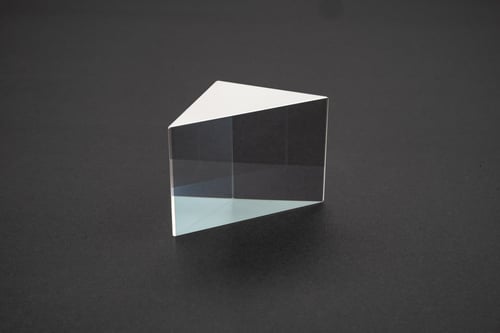
Common prism types and their applications
|
Prism |
Function |
Typical applications |
|
Right-angle prism |
Deviates a beam by 90° or 180° |
Folding optical paths, periscopes |
|
Penta prism |
Deviates a beam by exactly 90° |
Metrology, alignment systems, rangefinders |
|
Dove prism |
Rotates an image as the prism rotates |
Image rotation, scanning systems |
|
Amici roof prism |
Erects an image and deviates the beam |
Sighting and viewing systems |
|
Schmidt-Pechan prism |
Produces an erect image in a compact optical path |
Night vision binoculars and monoculars |
|
Porro prism pair |
Produces an erect image with an offset optical path |
Traditional binoculars |
|
Beamsplitter cube |
Splits or combines light paths |
Rangefinders, sensors, binocular viewers |
|
Corner cube |
Returns a beam parallel to the incoming beam |
Laser tracking and ranging systems |
The prism selected depends on the optical function required, available space within the system and any environmental or alignment constraints.
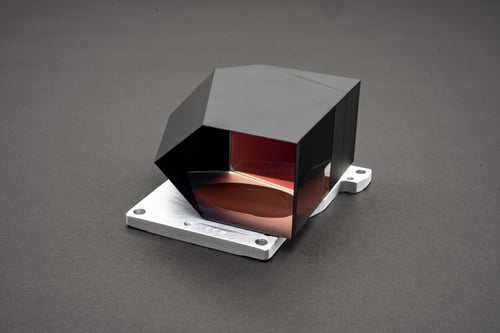
Prism selection in rangefinders
Laser rangefinders often combine viewing optics, laser transmission and display information within the same housing. Prisms are frequently used to fold optical paths, reduce package size and combine visible and laser channels.
Beamsplitter cubes and prism assemblies can separate visible and laser wavelengths while maintaining alignment between different optical paths. In systems where optical alignment directly affects ranging accuracy, prism quality and assembly tolerances become critical to overall performance.
Penta prisms are also used in some alignment and ranging systems because they maintain a precise 90° beam deviation even if the prism itself is slightly rotated.
Prisms in night vision systems
Night vision monoculars and binoculars rely on prisms to keep optical systems compact while presenting a correctly oriented image to the user.
Roof prism designs such as Schmidt-Pechan prisms are commonly used where a straight-through optical path is required. Beamsplitter prisms may also be incorporated in bi-ocular systems, allowing the output from a single image intensifier tube to be viewed with both eyes.
The optical coatings applied to these prisms are often as important as the prism geometry itself, influencing transmission, image brightness and overall system performance.
Aerospace and optical metrology applications
Prisms are used throughout aerospace optical systems, including sighting devices, head-up displays, navigation instruments and laser-ranging equipment. Their ability to fold and redirect optical paths allows complex systems to be packaged within confined spaces.
In optical metrology, penta prisms are widely used for straightness and squareness measurements because the beam deviation remains fixed at 90°. Corner cubes are commonly used as reference targets in laser tracking systems, returning light back towards the source without requiring precise angular alignment.
Integrating reticles and prism assemblies
In many rangefinders, sighting systems and night vision devices, optical performance depends on the alignment between the prism assembly and the reticle.
Depending on the optical design, a reticle may be positioned adjacent to the prism assembly, aligned to a prism surface or incorporated as part of a larger optical subassembly. Maintaining this relationship is important for preserving boresight accuracy and ensuring the reticle remains correctly positioned within the optical path.
This is one reason why prism manufacture, reticle production and optical assembly are often considered together during system development rather than as separate components.
Environmental considerations
Prisms used in aerospace, defense and field-deployed optical systems must maintain alignment and optical performance through shock, vibration, temperature cycling and humidity exposure.
Environmental requirements often influence material selection, coating design and assembly methods, particularly where bonded prism groups or complex optical assemblies are involved.
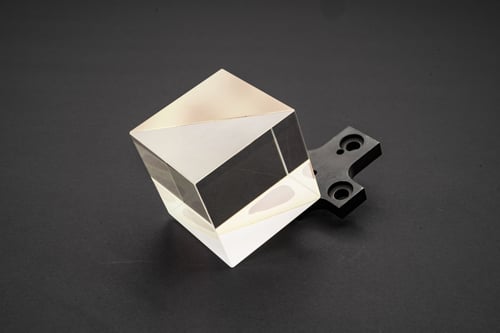
Matching the prism to the application
Different applications place different demands on a prism assembly. A prism used to fold an illumination path may require very different specifications from one used in a rangefinder, metrology instrument or night vision system.
Selecting the appropriate prism type early in the design process can simplify packaging, reduce alignment complexity and improve overall system performance.
Discuss your application with our team
We manufacture custom prisms and prism assemblies for aerospace, defense, metrology and precision imaging applications. Please contact our technical sales team to discuss your requirements: sales@torrentphotonics.com.