
Laser damage threshold (LDT), often referred to as laser-induced damage threshold (LIDT), is a key specification for optics used in laser rangefinders, LiDAR systems, laser designators and other pulsed laser applications. Although coating datasheets may report a single LDT value, actual performance depends on several factors, including substrate preparation, coating materials, deposition processes and test conditions.
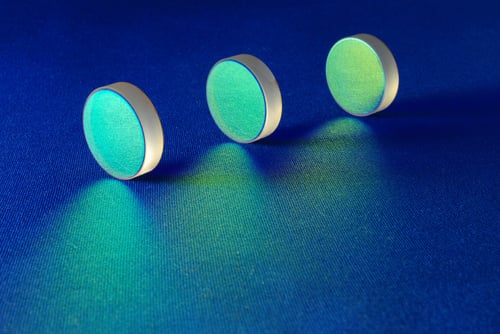
Defects are often the limiting factor
In nanosecond laser systems, damage rarely begins within the bulk material. More commonly, it originates at localised defects that absorb laser energy and create hotspots.
These defects can include residual polishing compounds, contamination, coating inclusions, voids within the film structure and microscopic surface imperfections. Once a damage site forms, continued laser exposure can enlarge the affected area, increasing scatter and reducing optical performance.
As a result, two optics with nominally identical coatings can exhibit significantly different damage thresholds.
Substrate preparation
Subsurface damage from grinding and polishing is a common source of absorption in high-energy laser optics. Microscopic cracks and trapped polishing residues can remain below an apparently flawless surface and become initiation sites for laser damage.
Surface defects can also affect coating uniformity and contribute to localised field enhancement within the coating stack.
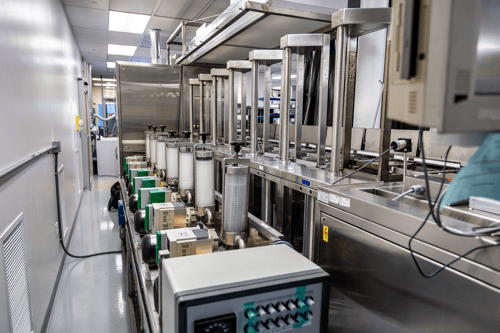
Cleanliness before coating
Particles, polishing residues and handling contamination introduced before coating can remain trapped within the coating stack. In high-fluence applications, these defects frequently become the locations where damage begins.
For this reason, contamination control during cleaning, handling and coating is an important part of producing optics for demanding laser applications.
We prepare optical substrates using an automated ultrasonic clean line with a HEPA filtered drying booth before coating within class 100/1000 cleanroom environments. These controls help minimize particulate contamination on critical optical surfaces and support the production of high-performance laser optics.
Coating process selection
Film density, absorption and defect density vary significantly between deposition methods.
Ion beam sputtering (IBS) is widely used for laser optics because it produces dense, low-scatter coatings with excellent environmental stability. Ion-assisted deposition (IAD) can also produce durable coatings with improved film properties compared with conventional evaporation processes and is often used where larger apertures or higher production volumes are required.
We use a range of coating technologies, including IBS, magnetron sputtering (MSP), electron-beam ion-assisted deposition and plasma ion-assisted deposition (PIAD). Different deposition methods offer different advantages in film density, durability, environmental stability and laser damage resistance, allowing coating designs to be selected according to the application's wavelength, operating environment and performance requirements.
Field distribution within the coating
Within a multilayer coating, electric-field intensity varies throughout the stack. The location of field maxima, together with the coating materials selected, influences how the coating responds to high laser fluence.
Coating architecture therefore becomes an important consideration alongside optical requirements such as reflectance, transmission and spectral bandwidth.
Interpreting LDT data
LDT values are only meaningful when reported alongside the test conditions. Wavelength, pulse duration, repetition rate, spot size and testing methodology can all influence the measured result.
When comparing coatings, it is important to determine whether the reported test conditions are representative of the intended application.
Discuss your application with our team
Torrent Photonics supports laser-based systems with precision optical components, optical coatings and integrated optical assemblies.
If you are developing a laser rangefinder, LiDAR platform or other laser application, our team can help identify coating solutions suited to your wavelength, pulse conditions and operating environment.
Request a quote or contact our team: sales@torrentphotonics.com