
In photonics manufacturing, environmental control is a practical requirement. Airborne particles, moisture, and other contaminants can affect optical coatings and sensitive components, introducing issues that may not become apparent until final inspection or system integration.
That is why we perform manufacturing, coating, assembly, and testing operations within ISO-certified Class 100, Class 1,000, and Class 10,000 cleanroom environments. These classifications define the level of airborne particle control maintained within each workspace and allow us to match the manufacturing environment to the requirements of specific optical processes.
Contamination and Optical Performance
Many optical components are sensitive to contamination during manufacturing and assembly.
Particles on optical surfaces can affect coating quality, increase scatter, interfere with alignment processes, or require additional cleaning and rework. As optical systems continue to push performance limits, contamination becomes harder to tolerate and more difficult to remove once introduced.
We view cleanrooms as a manufacturing tool rather than a facility feature. The environment in which an optic is coated, assembled, and tested can be just as important as the equipment used to manufacture it.
Why We Use Different Cleanroom Classifications
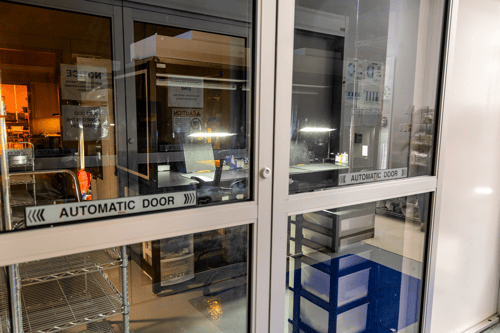
Not every manufacturing process requires the same level of environmental control.
The Class 100, Class 1,000, and Class 10,000 designations refer to the concentration of airborne particles permitted within a controlled environment. The lower the number, the cleaner the environment.
A Class 100 cleanroom allows far fewer airborne particles than a Class 1,000 environment, while a Class 1,000 cleanroom maintains stricter particle control than a Class 10,000 cleanroom. We use different cleanroom classifications because not all manufacturing activities have the same contamination requirements.
In photonics manufacturing, even microscopic particles can affect optical surfaces, coatings, assemblies, and test results. Having Class 100, Class 1,000, and Class 10,000 cleanrooms means coating, assembly, and testing activities can be carried out under the level of environmental control each process requires.
Cleanrooms and Optical Coatings
Optical coating performance depends on more than deposition equipment and process parameters. Surface preparation, cleanliness, and environmental control all influence the final result.
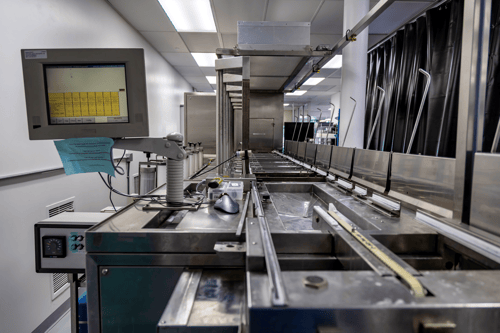
Before entering the coating process, optical substrates must be thoroughly cleaned to remove particles and residues that could affect coating adhesion or performance. Our automated cleaning lines help ensure substrates are prepared consistently before coating begins, reducing the risk of contamination being introduced during handling.
Environmental control becomes particularly important for laser coatings. Even extremely small particles on a substrate surface can become incorporated into the coating stack, potentially affecting coating uniformity, increasing scatter, or creating localized defects. In high-power laser applications, contamination can have a direct impact on coating performance and durability.
Clean substrates, automated cleaning lines, and controlled coating environments all contribute to coating consistency. For laser coatings, controlling contamination before coating begins is just as important as the deposition process itself.
Cleanrooms and Optical Assembly
Assembly presents its own contamination challenges. Many optical systems require lenses, filters, mirrors, prisms, detectors, and other precision components to be integrated into a single assembly. Even when individual components meet specifications, contamination introduced during assembly can affect optical interfaces, alignment, and overall system performance.
To support contamination-sensitive assembly work, we operate dedicated Class 100 and Class 1,000 cleanroom assembly areas equipped with multiple assembly cells.
These assembly areas are used for contamination-sensitive builds where cleanliness must be maintained throughout the assembly process.
The Role of Nitrogen Purge Chambers
Airborne particles are not the only concern during optical assembly. Moisture and environmental exposure can also affect sensitive optical components and assemblies during handling and integration.
Nitrogen purge chambers are particularly useful where exposure to moisture or airborne contaminants needs to be minimized during assembly and integration.
Why Testing Is Performed in Controlled Environments
Testing is the final verification step before components or assemblies move on to customers or system-level integration.
Introducing contamination during testing can affect measurements, require additional cleaning, or increase handling of sensitive components. Performing testing within controlled environments reduces handling risks and helps keep optical components in the same condition in which they were assembled.
It also reduces the risk of introducing contamination after performance has already been measured and verified.
What Matters Beyond the Class Rating
When evaluating a manufacturing partner, engineers typically look beyond a cleanroom classification alone.
The more important question is how contamination control is incorporated into the manufacturing process.
Areas that are often considered include:
- Optical coating operations performed within controlled environments
- Dedicated cleanroom assembly areas
- Nitrogen purge capabilities
- Inspection and testing conducted under controlled conditions
- Quality management systems and documented process controls
- Consistency across manufacturing, assembly, and testing
These factors often provide a clearer indication of manufacturing capability than a cleanroom rating by itself.
Environmental Control Throughout Manufacturing
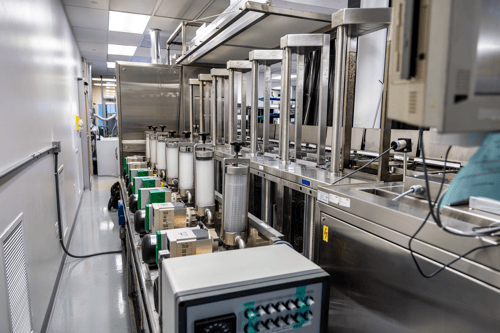
Cleanrooms are used throughout photonics manufacturing because contamination can affect coating quality, assembly processes, testing, and ultimately system performance.
At Torrent Photonics, we operate ISO-certified Class 100, Class 1,000, and Class 10,000 cleanrooms that support coating, assembly, and testing activities. Our dedicated Class 100 and Class 1,000 assembly areas include multiple assembly cells and nitrogen purge chambers for contamination-sensitive manufacturing processes.
Alongside our ISO 9001:2015 and AS9100D certifications and ITAR registration, these cleanrooms are used throughout our coating, assembly, and testing operations for coated optics, optical assemblies, and photonic systems.
Contact our team today if you'd like to find out more about our capabilities: sales@torrentphotonics.com