
Most aspheric lens problems don't start on the shop floor. They start weeks earlier, at a desk, when a designer specifies a surface that looks correct in Zemax or CODE V but can't be cut, polished, and measured the way it's written.
By the time that print reaches a fabricator, the options are limited. Either the shop pushes back and the project stalls while both sides work out what the design can tolerate, or the shop tries to hold the print as written and the cost and lead time climb to match. Neither outcome serves the customer, and both are avoidable if the conversation happens earlier.
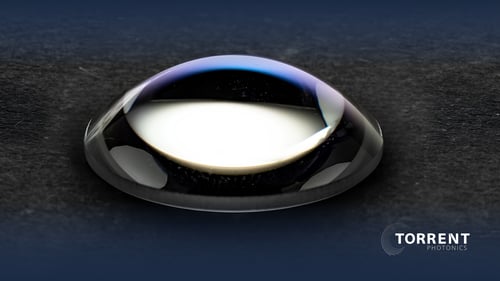
What "unmanufacturable" looks like
An aspheric surface is described mathematically: base radius, conic constant, and a series of higher-order terms that bend the profile away from a sphere. Most of the time, that equation behaves well across the lens. Occasionally it doesn't. Near the edge of the clear aperture, the local slope can steepen sharply, or the equation can call for behavior outside the aperture that no CNC toolpath can follow, even with standard mathematical extensions.
None of that shows up as an error in the design software. It shows up when a fabricator tries to import the print into a machine and the toolpath fails, or when the surface comes off tolerance in a way that no amount of polishing time will fix.
A design that almost didn't happen
Torrent Photonics worked with an equipment manufacturer whose custom aspheric lens hit exactly this problem. The surface equation went unstable outside the clear aperture, so it couldn't be reliably programmed into the fabrication process, even with the extensions typically used to handle that kind of edge behavior. As written, the part was close to a no-bid: a design most shops would decline rather than fight.
Instead of turning the job away, Torrent's engineers worked directly with the customer's design team to redefine the surface equation in a form that held the same optical performance but could be clearly documented on the print and imported straight into the CNC workflow. The fix didn't change what the lens needed to do. It changed how that requirement was described, so the description matched what grinding and polishing equipment can execute.
That part has been in production for years. A design that started as a likely rejection became a long-running program, and the only difference was when the fabricator got involved.
Why timing matters more than most designers assume
Optical designers are not expected to know the limits of every fabrication process, and most don't have visibility into what makes one aspheric profile straightforward to produce and another one problematic or unmanufacturable. That's not a knowledge gap that needs fixing. It's the reason fabrication input during design exists in the first place.
The problem is that this input usually arrives too late to matter. Many optical designers still bring fabricators in at the quoting stage, once the print is close to final, when the design has already absorbed weeks of engineering time and the cost of changing course is highest. A five-minute conversation about clear aperture behavior during the design phase can save a full re-spec cycle after the print is locked.
This is design for manufacturability in practice: not a checklist applied at the end, but small adjustments made early, before assumptions about cost, tolerance, or geometry get built into a print that then must be unwound.
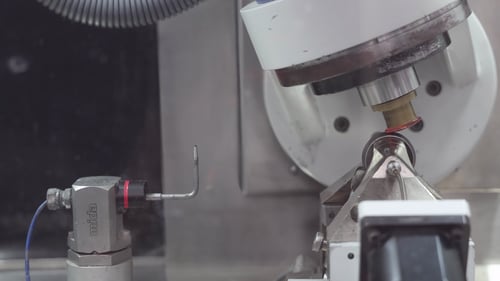
What early engagement changes
When a fabricator reviews an aspheric design before it's finalized, a few things typically happen.
The equation gets checked for edge behavior across the full clear aperture, not just the central region a designer might have modeled most carefully.
Tolerances get matched to what the application requires, rather than defaulting to a tighter spec than the system needs, which drives up cost without improving performance.
Material and geometry choices get reviewed against what's realistic to produce at the required volume, whether that's a single prototype or a multi-year production run.
None of this requires the designer to know fabrication in depth. It requires a conversation before the print is treated as finished.
The bigger picture
Aspheric lenses have a reputation for being expensive and slow to produce, built from decades when that was largely true. Advances in CNC fabrication, sub-aperture polishing, and metrology have narrowed that gap significantly, and a single asphere replacing several spherical elements often comes out ahead on total system cost once assembly and part count are factored in. But none of that potential gets realized if the design itself can't be manufactured as written.
The fix isn't more caution at the design stage. It's earlier contact with the people who will actually fabricate the part.
If you're working on an optical system where an aspheric surface might simplify the design, Torrent's engineering team can review it before the print is finalized.
Visit the aspheric lenses page to see how design-stage input has changed outcomes for other programs or contact our technical team directly to talk through a specific design.